

The Complete Guide to Psychologist Marketing in 2026

This guide was written by the team at neticé, a Melbourne-based search marketing agency with experience running AHPRA compliant campaigns for Australian health practices. All references to AHPRA advertising requirements are drawn from the official AHPRA Advertising Guidelines, available at ahpra.gov.au. This guide does not constitute legal or regulatory advice.
Table of Contents
Introduction
How Psychology Patients Search Today
Understanding the Patient Decision Journey
AHPRA Advertising Guidelines, What Psychologists Need to Know
E-E-A-T and Why Google Evaluates Health Content Differently
Your Psychology Practice Website, The Foundation of Everything
Local SEO for Psychologists
On-Page SEO for Psychology Practices
Technical SEO for Psychologists
Content Marketing for Psychologists
Google Ads for Psychologists
Google Business Profile for Psychologists
Psychology Practice Directory Listings
Social Media for Psychologists
Email Marketing for Psychology Practices
Telehealth and Online Psychology Marketing
Marketing for Specialist Psychology Practices
How to Choose a Psychology Marketing Agency
Key Metrics and How to Measure Marketing Performance
Building Your Psychology Marketing Plan for 2026
1. Introduction
Psychology practices across Australia are navigating a marketing landscape that looks fundamentally different from five years ago. The way patients find practitioners has shifted. The platforms they use have changed. The expectations they bring to a first appointment, shaped by what they found online before they ever made contact, have risen considerably.
At the same time, Google has significantly raised the bar for health and medical content. Under its E-E-A-T framework, Experience, Expertise, Authoritativeness, and Trustworthiness, Google evaluates psychology practice websites with a higher level of scrutiny than most other categories. Health content sits in what Google calls Your Money or Your Life (YMYL) territory: content that can directly affect a person's wellbeing. Ranking well in this category requires genuine credentials, accurate information, and a website that communicates both clearly.
The regulatory environment governing how psychologists can advertise has remained strict throughout all of this. AHPRA's advertising guidelines place clear limits on the claims practitioners can make, the language they can use, and the social proof they can deploy. Navigating these requirements while building a genuinely effective marketing presence is one of the central challenges of running a psychology practice in 2026.
This guide covers everything a psychology practice needs to understand about marketing: from how patients search and what they are looking for, through to SEO, Google Ads, social media, directories, telehealth, and how to build a marketing plan that fits your practice model and your budget. Every recommendation in this guide has been written with both AHPRA compliance and Google's E-E-A-T requirements in mind.
At neticé, we specialise in search marketing for psychology practices. If you would like to talk through your practice's marketing before reading further, get your free audit here.
2. How Psychology Patients Search Today
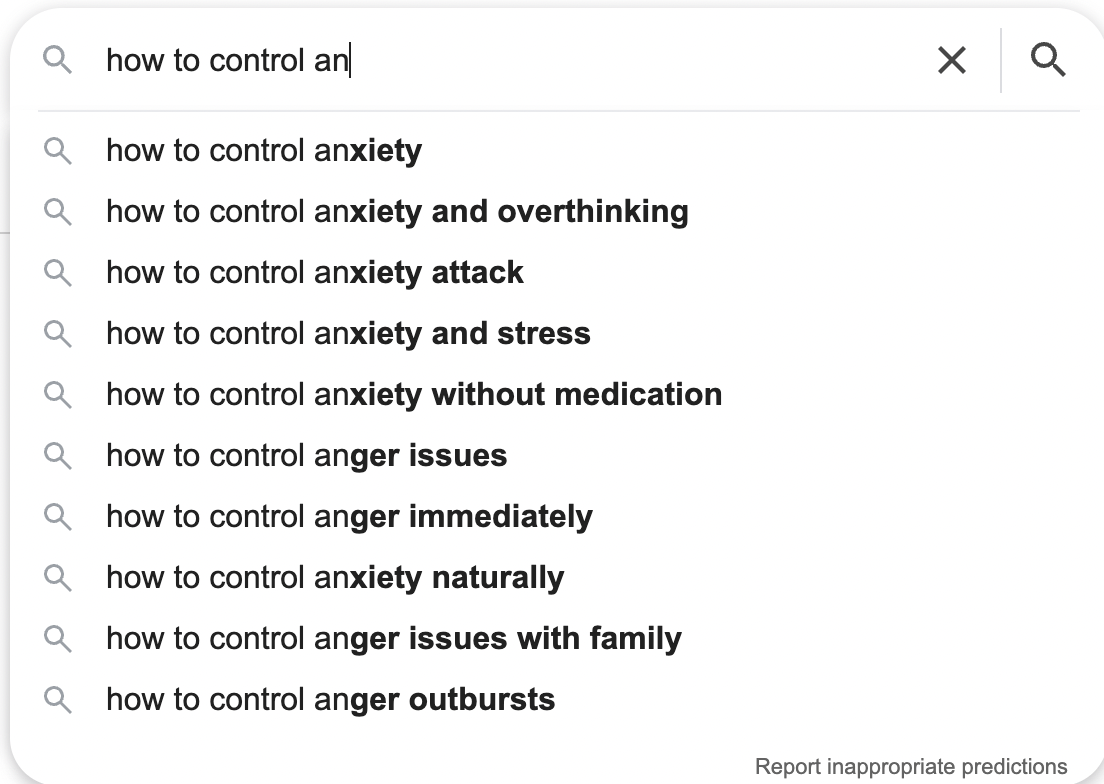
Understanding how potential patients search for psychological support is the foundation of any effective marketing strategy. If your practice is visible in the wrong places, at the wrong moment, or for the wrong searches, even the best website will underperform.
Search behaviour in 2026
The majority of people who seek psychological support begin their search on Google. They do not start by calling their GP. They start by searching privately, often late at night, often on a mobile device, and often using language that reflects their personal experience rather than clinical terminology.
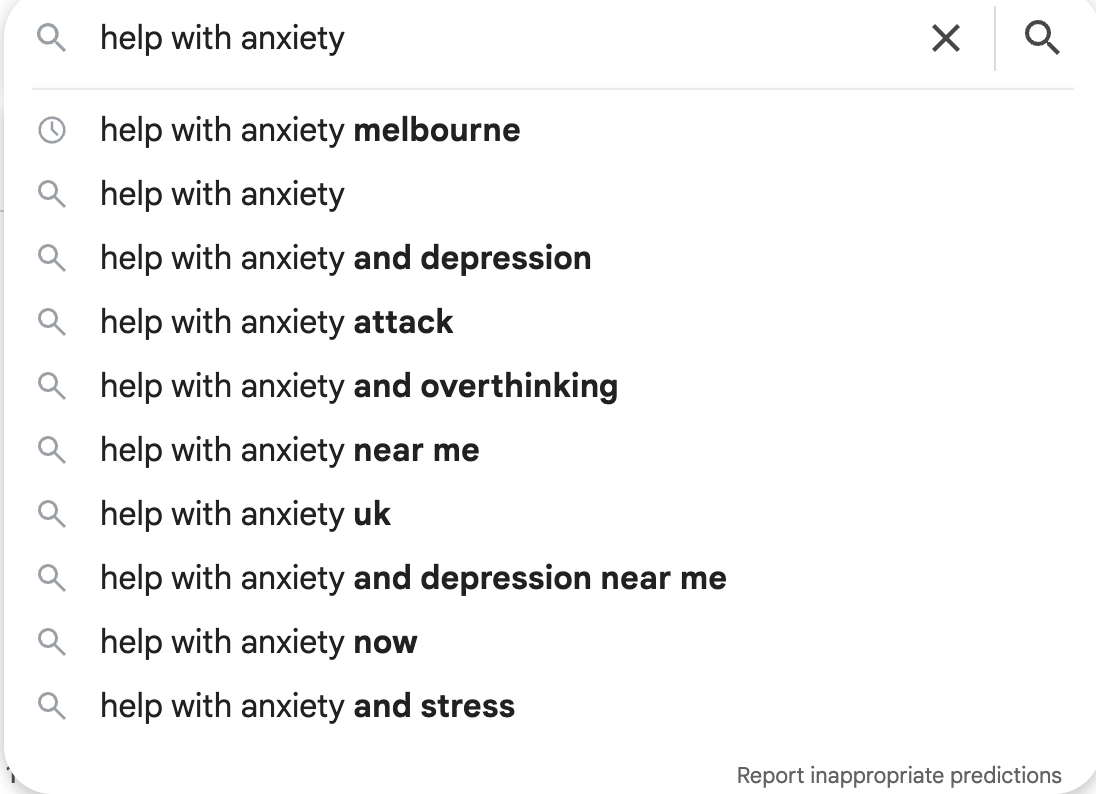
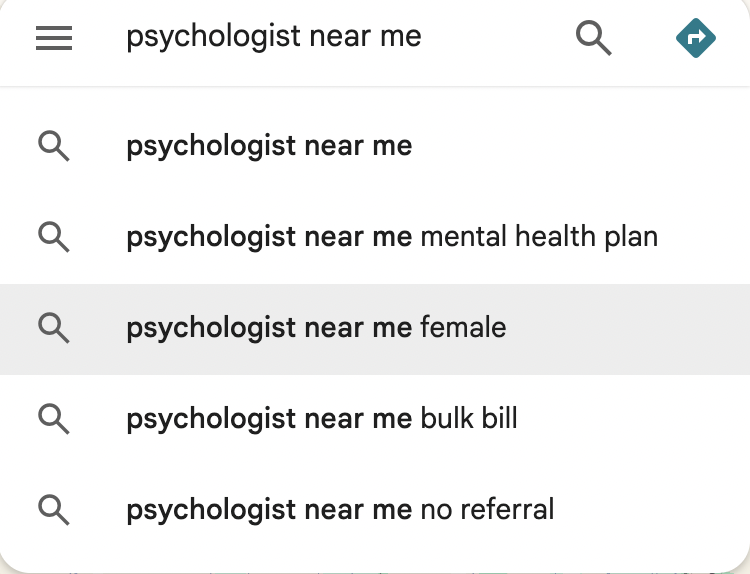
A person experiencing anxiety does not typically search "psychologist anxiety treatment Melbourne." They search "help with anxiety Melbourne" or "psychologist near me" or the name of a specific therapy approach they have heard about. Understanding this distinction shapes how you build your content, your keywords, and your Google Ads campaigns.
Think with Google research consistently shows that health-related searches are among the most personal and high-intent searches people conduct. The moment a person searches for psychological support, they are often already committed to seeking help. They are evaluating options, and your practice's visibility and credibility at that moment directly influences whether they make contact.
Mobile and "near me" searches
The majority of health-related searches in Australia now happen on mobile devices. "Psychologist near me" and "psychologist [suburb]" searches have grown consistently year on year. Local visibility is no longer optional for psychology practices, it is the primary battleground for new patient acquisition in most metropolitan and regional areas.
The role of search intent
Not all searches carry the same intent. Informational searches"what is CBT therapy" indicate someone in an early research phase. Navigational searches "[practice name] psychology" indicate someone already aware of your practice. Transactional searches "book psychologist Melbourne" indicate someone ready to act.
A complete psychologist marketing strategy addresses all three intent types: building content for the informational phase, ensuring your practice is easy to find for navigational searches, and optimising your Google Ads and local listings for transactional searches.
3. Understanding the Patient Decision Journey
Before a patient books their first appointment, they typically move through several distinct stages. Marketing that ignores this journey tends to focus all of its effort on the final step, missing the opportunity to build trust and visibility earlier in the process.
Stage 1: Recognition
The patient recognises that they are experiencing something they want support with. This stage often happens privately. Content that speaks directly to lived experience, framed accurately and without exploiting vulnerability in line with AHPRA requirements, can place your practice in front of people at this early stage.
Stage 2: Research
The patient begins actively searching for information and options. This is where SEO, content marketing, and your Google Business Profile do their most important work. The practices that appear consistently across multiple search queries during this phase build familiarity and trust before any contact is made.
According to the Australian Institute of Health and Welfare, mental health is one of the leading health concerns across all age groups in Australia, with demand for psychological services continuing to grow. This means patients are often evaluating multiple practitioners simultaneously. Your online presence is frequently your first impression.
Stage 3: Evaluation
The patient compares options. They look at websites, read about therapeutic approaches, review practitioner profiles, and assess how well a practice communicates who it is and who it serves. Practices with clear, credible, and well-structured online presences consistently convert better at this stage. Under Google's E-E-A-T framework, this credibility is also a ranking factor, Google rewards the same qualities patients look for.
Stage 4: Decision and contact
The patient makes contact. The ease of this step matters more than most practices realise. A phone number that is hard to find, a contact form that does not work on mobile, or an intake process that feels unclear can lose a patient who was already committed to booking.
Stage 5: Ongoing relationship
Marketing does not end at the first booking. Referral network relationships, Google Business Profile management, and a consistent content presence all contribute to sustainable practice growth over time.
4. AHPRA Advertising Guidelines, What Psychologists Need to Know
Every marketing decision a psychology practice makes sits within the framework of AHPRA's advertising guidelines. These guidelines apply to all registered health practitioners in Australia and cover every form of advertising, from your website and Google Ads to your social media profiles and directory listings.
Understanding the core requirements is essential. Getting them wrong carries genuine professional risk.
Testimonials
Patient testimonials are not permitted in advertising by registered health practitioners. This applies regardless of how positive the testimonial is, whether the patient has provided written consent, or whether the testimonial appears on a third-party platform. Quoting or featuring patient reviews in your advertising material falls outside AHPRA guidelines.
Unsubstantiated claims
Any claim you make about your services must be accurate and capable of being substantiated. Terms like "leading," "best," "expert," or "number one" are not permitted unless they can be formally substantiated with credible evidence. Comparative claims about other practitioners or practices are also prohibited.
Fear-based language
Marketing that uses anxiety, urgency, or emotional pressure to prompt people to seek your services is not permitted. Content must not imply that a patient's condition will worsen without immediate treatment unless that claim is clinically substantiated.
Discounts and promotional pricing
Promotional pricing, limited-time offers, and discount advertising are not permitted for psychology services. Pricing information can be included on your website but must be presented accurately and without promotional framing.
What AHPRA compliant marketing looks like in practice
Effective AHPRA compliant marketing focuses on clear, accurate descriptions of your services, your qualifications, your approach, and the patient population you work with. It uses language that is honest and grounded rather than promotional or emotionally manipulative.
The full requirements are more detailed than most practitioners realise. We have produced a free AHPRA Advertising Compliance Checklist specifically for psychology practices, covering website, Google Ads, and social media requirements in detail. Download the free checklist here.
For the authoritative source, always refer to the current AHPRA Advertising Guidelines at ahpra.gov.au.
5. E-E-A-T and Why Google Evaluates Health Content Differently
Google's E-E-A-T framework, Experience, Expertise, Authoritativeness, and Trustworthiness, is the lens through which Google's quality raters evaluate web content. For psychology practices, understanding E-E-A-T is not optional. Health content sits in what Google calls Your Money or Your Life (YMYL) territory, meaning content that can directly affect a person's health, safety, or financial wellbeing. Google applies its highest level of scrutiny to YMYL content.
The practical implication is that a psychology practice website must demonstrate genuine credentials, real experience, and authentic trustworthiness, not through promotional language, but through verifiable signals.
Experience
Google rewards content that demonstrates first-hand experience with the subject matter. For a psychology practice, this means your website and content should reflect real clinical experience. Practitioner profiles should be specific and detailed. Blog content should demonstrate genuine clinical knowledge rather than generic information readily available anywhere on the web.
Expertise
Expertise signals include your formal qualifications, your AHPRA registration, your professional memberships with bodies such as the Australian Psychological Society, your areas of specialisation, and any postgraduate training or accreditations. These should be clearly and accurately communicated on your website, particularly on practitioner profile pages.
Authoritativeness
Authoritativeness is built over time through consistent, high-quality content, references from credible external sources, directory listings on authoritative health platforms, and links from reputable websites. A practice that is listed accurately on Healthdirect, the APS Find a Psychologist directory, and other credible health directories builds authoritativeness signals that support search rankings.
Trustworthiness
Trustworthiness encompasses the accuracy of your content, the security of your website (HTTPS is essential), the transparency of your pricing and intake process, and the clarity of your contact information. Content that makes accurate, substantiated claims, and avoids the overclaiming that AHPRA prohibits, also builds the trustworthiness signals Google rewards.
The important point for psychology practices is that AHPRA compliant marketing and E-E-A-T optimised marketing are largely the same thing. Both require honesty, accuracy, genuine credentials, and content grounded in real expertise. A practice that markets itself well within AHPRA guidelines is also, in most respects, marketing itself well for Google.
6. Your Psychology Practice Website, The Foundation of Everything
Every other element of your marketing strategy sends traffic somewhere. In almost every case, it sends traffic to your website. A website that fails to convert that traffic into patient inquiries wastes every dollar and every hour invested in the marketing that drives people to it.
What a high-performing psychology practice website needs
Clarity comes first. A visitor should understand within seconds who you are, what you offer, and who you work with. Specific language about the presentations you work with, the populations you serve, and how patients can expect to work with you is far more effective than vague descriptions of "evidence-based" or "holistic" approaches.
Trust signals matter significantly in health. Your qualifications, your AHPRA registration number, your professional memberships, and your clinical experience should be clearly and accurately communicated. In the absence of patient testimonials, which AHPRA prohibits, the credibility of your practitioner profiles carries considerable weight with both prospective patients and Google's E-E-A-T evaluation.
Mobile performance is essential. The majority of patients visiting your website for the first time will do so on a mobile device. A website that loads slowly or has a contact process that is difficult on mobile will lose patients who were ready to book.
Clear calls to action guide patients toward making contact. Your phone number, your online booking link, and your contact form should be visible on every page.
Conversion-focused page structure
Your homepage should communicate who you are and who you serve. Your services pages should be structured around the specific presentations, therapy modalities, and patient populations you work with, because these are what patients search for. Your about page should build personal credibility through accurate credential communication. A blog or resources section builds content authority and captures informational search traffic.
For guidance on how Google evaluates website quality, refer to Google Search Central's page experience documentation.
7. Local SEO for Psychologists
Local SEO is the single highest-impact marketing investment available to most psychology practices. When someone searches "psychologist [suburb]" or "psychologist near me," the practices that appear in Google's local results capture the majority of clicks.
Google Business Profile

Your Google Business Profile is the most important local SEO asset your practice has. A fully optimised profile, with accurate contact information, correct business categories, complete service descriptions, regularly updated photos, and active use of the Q&A and posts features, significantly improves your visibility in local search results.
The primary category for a psychology practice should be "Psychologist." Secondary categories can include "Mental Health Clinic" or "Counsellor" where relevant. Your business name must match your actual practice name exactly. Keyword additions to the business name field violate Google's guidelines and can result in profile suspension.
For complete guidance, refer to Google's official Business Profile help documentation.
Local citations and directory consistency
Google evaluates the consistency of your practice's name, address, and phone number (NAP) across the web as a local SEO signal. Listings on relevant directories, including Healthdirect, the APS Find a Psychologist directory, and Halaxy, build local authority when they are accurate and consistent.
Any inconsistency across listings, a different phone number, a variation in the practice name, or an outdated address, reduces the local authority signal these listings would otherwise provide.
Suburb-specific content
Beyond your Google Business Profile, creating location-specific content on your website builds local search relevance. Service pages that address the specific suburbs and regions your practice serves, written with genuine local context rather than keyword-stuffed filler, contribute meaningfully to local search visibility.
8. On-Page SEO for Psychology Practices
On-page SEO involves optimising the content and structure of individual pages on your website so that Google can understand what each page is about and match it accurately to relevant search queries.
Keyword research for psychologists

Effective keyword research for psychology practices starts with understanding how your potential patients search, not how clinicians describe services. Tools including Ahrefs and Google's own Keyword Planner reveal the actual search terms patients use and the volume of searches each term generates.
Presentation-based keywords "CBT therapist Melbourne," "EMDR psychologist Sydney" tend to be lower volume but higher intent, the person searching knows what they are looking for and is closer to booking. Location-based keywords "psychologist Fitzroy," "psychologist inner north Melbourne" capture local intent. Modality-based keywords "schema therapy Melbourne" "ACT therapist Brisbane" reach patients who have researched therapeutic approaches and are looking for a specific type of support.
Page titles and meta descriptions
Every page on your website should have a unique title tag that includes the primary keyword for that page and clearly describes the page's content. Meta descriptions do not directly influence rankings, but they do influence click-through rates from search results. A well-written meta description communicates clearly what the page offers and gives the searcher a reason to click.
Heading structure
A clear heading hierarchy, one H1 per page, followed by H2 and H3 subheadings, helps Google understand the structure and topic of your content. Headings should describe the content that follows them accurately rather than functioning as keyword placements.
Internal linking
Linking between related pages on your website helps Google understand the relationship between your content and distributes page authority across your site. A blog post about CBT for anxiety should link to your anxiety treatment service page. Your service pages should link to relevant blog content and to your contact or booking page.
9. Technical SEO for Psychologists
Technical SEO refers to the underlying structure and performance of your website, the factors that affect how efficiently Google can crawl, index, and rank your pages, independent of the content itself.
Site speed and Core Web Vitals

Google uses Core Web Vitals as a ranking factor. These metrics measure how quickly your pages load, how stable the layout is as it loads, and how quickly the page responds to user interaction. A psychology practice website with a slow load time, particularly on mobile, will be penalised in rankings relative to faster competitors.
For current Core Web Vitals benchmarks and guidance, refer to Google Search Central's Core Web Vitals documentation.
HTTPS
A website without HTTPS, indicated by a padlock in the browser address bar, is flagged as insecure by Google and by browsers. For a psychology practice website, where visitors are sharing personal health information, the absence of HTTPS also undermines the trustworthiness signals that E-E-A-T requires. HTTPS is a baseline requirement.
Mobile friendliness
Google indexes the mobile version of your website first. A website that is not fully functional and well-designed on mobile devices will underperform in rankings regardless of how strong its desktop experience is.
Structured data
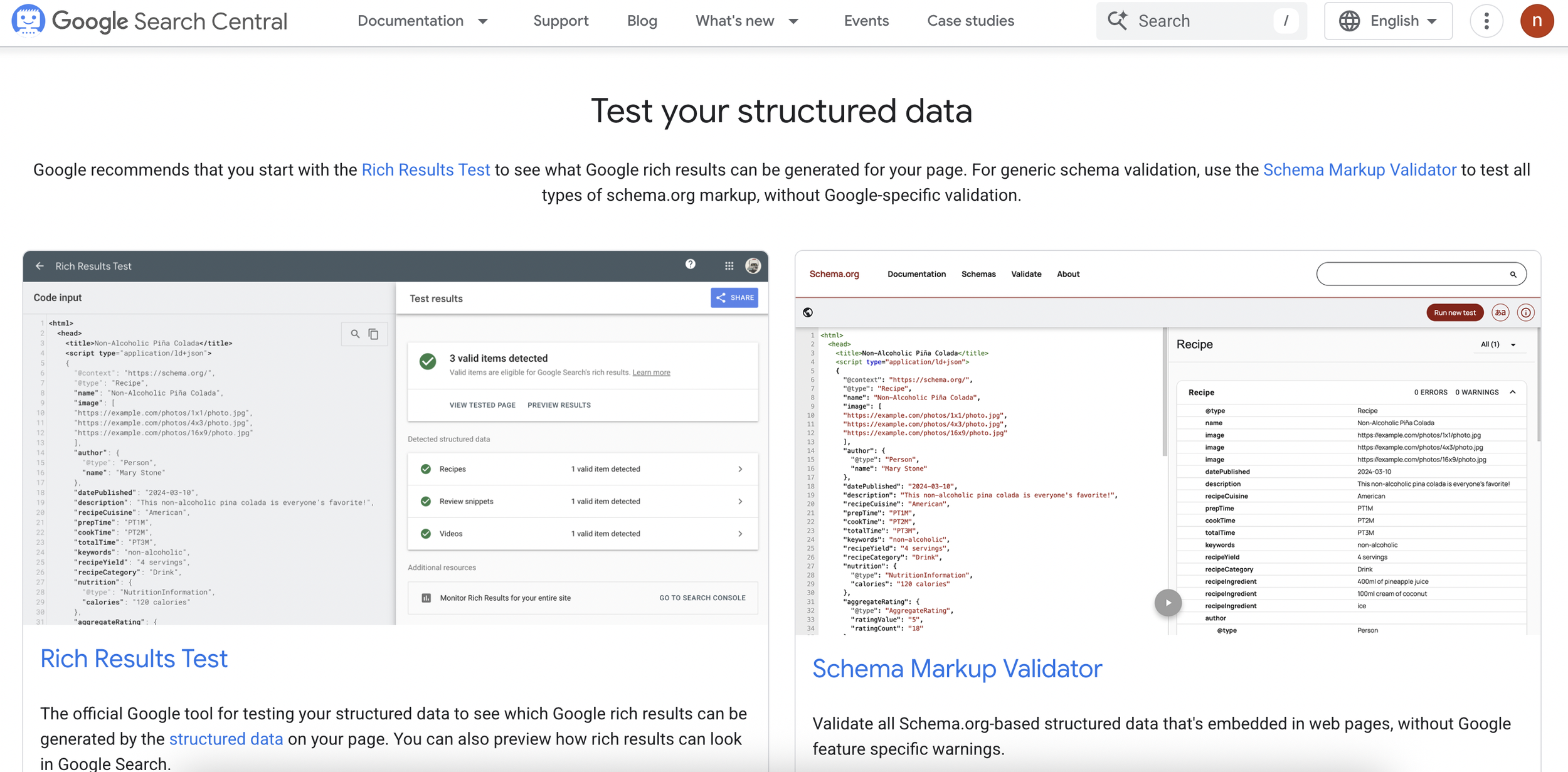
Structured data, implemented through Schema markup, allows you to communicate specific information about your practice to Google in a standardised format. For psychology practices, LocalBusiness and MedicalBusiness schema communicate your location, contact details, opening hours, and services in a way that Google can use directly in search results. Practitioner schema on individual profile pages communicates clinician credentials.
Indexation and crawlability
Google can only rank pages it can find and index. A technical audit of your website should confirm that your important pages are being crawled and indexed correctly, that there are no broken links or redirect errors, and that your sitemap is accurate and submitted to Google Search Console.
10. Content Marketing for Psychologists
Content marketing for psychologists involves creating genuinely useful, accurate, and credible content that serves your potential patients' information needs while building your practice's search visibility and E-E-A-T signals.
Why content marketing matters for psychology practices
A psychology practice that publishes consistent, high-quality content about the presentations it treats, the therapeutic approaches it uses, and the questions patients commonly have builds authority in Google's eyes over time. Each piece of well-optimised content is an additional entry point into your website from search, capturing patients at the research stage of their decision journey.
Content marketing also directly supports E-E-A-T. Content written by a registered psychologist, drawing on genuine clinical experience, and reviewed for accuracy carries far more weight with Google than generic health content produced without credentialled expertise.
AHPRA compliant content

All content published on a psychology practice website is subject to AHPRA's advertising guidelines. Blog posts, practitioner bios, service descriptions, and resource articles must all meet the same standards as your paid advertising. This means no patient testimonials, no unsubstantiated claims about outcomes, and no fear-based language.
Within these requirements, there is significant scope for genuinely useful content. Accurate explanations of therapeutic modalities, clear descriptions of what patients can expect from different types of therapy, and information about how to find the right psychologist all serve real patient needs without breaching AHPRA guidelines.
Content topics that build search visibility for psychology practices
Presentation-based content "Understanding generalised anxiety disorder," "What is complex PTSD" captures informational search traffic from patients researching their own experiences. Therapy modality content "How CBT works," "What to expect from EMDR therapy" reaches patients who are comparing therapeutic approaches. Practical content "How to find a psychologist in Melbourne," "What happens in a first psychology appointment" captures patients in the evaluation stage of their decision journey.
Each of these content categories can be developed into a cluster of related articles, all linking back to your core service pages, building the topical authority that Google rewards.
Author credentials and E-E-A-T
Every piece of content on your website that touches on health should have a clearly identified author with verifiable credentials. An author bio that includes the practitioner's AHPRA registration status, their qualifications, and their clinical experience directly supports the Expertise and Authoritativeness signals Google evaluates. Anonymous health content carries significantly less E-E-A-T weight than content attributed to a credentialled clinician.
11. Google Ads for Psychologists
Google Ads places your practice at the top of search results immediately, ahead of the organic rankings that take time to build. For psychology practices looking to fill appointment capacity quickly, or to complement a long-term SEO strategy with immediate visibility, Google Ads is a highly effective channel.
Campaign structure for psychology practices
Effective Google Ads campaigns for psychologists are structured around specific search intent rather than broad keyword categories. Separate ad groups for presentation-based keywords, location-based keywords, and therapy modality keywords allow you to write ad copy that is directly relevant to each search query, improving quality scores and reducing cost per click.
Broad match keywords in isolation tend to generate irrelevant traffic for psychology practices. A tightly managed campaign using a combination of phrase match and exact match keywords, supported by a comprehensive negative keyword list, keeps your budget focused on the searches most likely to result in a patient inquiry.
AHPRA compliant Google Ads copy
Every element of your Google Ads copy, headlines, descriptions, and extensions, is subject to AHPRA's advertising guidelines. Patient testimonials cannot appear in ad copy. Unsubstantiated superlatives are not permitted. Fear-based language is prohibited.
Within these requirements, effective ad copy for psychology practices focuses on clear descriptions of the services offered, the presentations treated, the locations served, and the process for making an inquiry. A straightforward, accurate, and clearly written ad consistently outperforms overclaimed or emotionally manipulative copy for high-intent health searches.
Google's healthcare advertising policies
Alongside AHPRA's guidelines, Google's own healthcare advertising policies place additional restrictions on psychology practice advertising. Certain remarketing approaches targeting users based on sensitive health conditions are restricted. Personalised advertising using health-related data requires careful management. For current policy details, refer to Google's healthcare and medicines advertising policies.
Conversion tracking
Google Ads without conversion tracking is budget spent without accountability. For psychology practices, conversions typically include phone calls from the website, contact form submissions, and online booking completions. Each of these should be tracked accurately so that campaign optimisation decisions are based on actual patient inquiries rather than clicks or impressions.
Landing pages
Sending paid traffic to a general homepage significantly reduces conversion rates. Campaigns structured around specific presentations or locations perform best when they land on pages specifically built for those searches, pages that directly address what the patient was searching for and make it easy for them to make contact.
For more on our approach to Google Ads for psychologists, visit our psychology marketing service page.
12. Google Business Profile for Psychologists
Your Google Business Profile is one of the most visible and high-impact assets your practice has in local search. It appears in the map pack at the top of local search results, in Google Maps, and in knowledge panels when patients search directly for your practice name.
Optimising your profile
A complete and accurate Google Business Profile includes your practice name, address, phone number, website, opening hours, and a detailed description of your services. The description field allows up to 750 characters and should describe your practice, your services, and the patient population you serve clearly and accurately, within AHPRA guidelines.
Photos of your practice, including the exterior, reception area, and consultation rooms, build familiarity and trust with potential patients before they visit. Profiles with photos consistently receive more engagement than those without.
Google Business Profile posts
The posts feature allows you to share updates, information about your services, and resources directly on your profile. Regular posts signal to Google that your profile is actively maintained and provide additional opportunities to communicate what your practice offers.
Questions and answers
The Q&A section of your Google Business Profile is publicly visible. Proactively adding accurate answers to common patient questions, about your intake process, your fee structure, your location and parking, and the types of support you offer, reduces barriers to contact and demonstrates the transparency that E-E-A-T requires.
13. Psychology Practice Directory Listings
Directory listings on authoritative health platforms build both local SEO signals and direct referral traffic. For psychology practices, several directories carry particular relevance.
Healthdirect
Healthdirect is the Australian Government's national health information service. A listing on Healthdirect carries strong authority signals and reaches patients actively seeking health services.
APS Find a Psychologist
The Australian Psychological Society's practitioner directory is one of the first places patients look when seeking a psychologist. A complete and accurate listing directly supports new patient acquisition.
Halaxy
Halaxy is a practice management platform widely used by Australian allied health practitioners. Its directory listing function reaches patients searching specifically for psychology services.
Psychology Today Australia
Psychology Today's Australian directory is a well-established referral source for psychology practices, particularly for practitioners working with specific presentations or populations.
Consistency across listings
Every directory listing must use exactly the same practice name, address, and phone number as your Google Business Profile and your website. Any inconsistency reduces the local authority signal these listings provide.
14. Social Media for Psychologists
Social media presents both an opportunity and a compliance responsibility for psychology practices. The same AHPRA advertising guidelines that apply to your website and Google Ads apply equally to every post, story, and profile element on every social platform.
What AHPRA prohibits on social media
Patient testimonials, even shared with the patient's permission, are not permitted. Reviews that constitute testimonials cannot be amplified or featured. Promotional pricing is not permitted. Fear-based or emotionally exploitative content is not permitted.
For current guidance on social media specifically, refer to AHPRA's social media guidance.
What works on social media for psychology practices
Educational content about mental health topics, written accurately and drawing on genuine clinical expertise, builds authority and reaches people in the early research phase of their decision journey. Content that describes therapeutic approaches, explains what patients can expect from therapy, or addresses common questions about seeking psychological support serves real patient needs within AHPRA guidelines.
Consistency matters more than volume. A practice that publishes two or three high-quality posts per week builds a more credible social presence than one that posts daily with generic or low-quality content.
Platform selection
For most psychology practices, Instagram and Facebook remain the highest-value social platforms in terms of reach and patient demographics. LinkedIn is valuable for building referral relationships with GPs, psychiatrists, and other allied health practitioners. The right platform mix depends on your patient population and your practice model.
15. Email Marketing for Psychology Practices
Email marketing for psychology practices is less about patient communication, which is governed by privacy legislation and clinical protocols, and more about building and nurturing referral relationships with GPs, psychiatrists, and other allied health practitioners who send patients your way.
Referral network communication
A regular, well-written communication to your GP and specialist referral network keeps your practice front of mind and communicates your areas of expertise clearly. This communication should include accurate information about your current availability, any changes to your services or fee structure, and any areas of specialisation that are relevant to the referrers you work with.
Content considerations
Any email communication that constitutes advertising is subject to AHPRA guidelines. Patient testimonials, unsubstantiated claims, and promotional language are not permitted in email marketing any more than they are on your website.
Australia's Spam Act also requires that commercial email communications include an unsubscribe mechanism and accurate sender identification. Ensure your email marketing practices comply with both AHPRA guidelines and the Spam Act.
16. Telehealth and Online Psychology Marketing
The growth of telehealth psychology has created both new patient acquisition opportunities and new marketing considerations. A practice that offers telehealth services can market to patients across a significantly broader geographic area than a practice limited to face-to-face appointments.
SEO for telehealth psychology
Telehealth psychology practices can target state-wide or national keywords in addition to local suburb searches. "Online psychologist Australia," "telehealth psychologist Medicare," and presentation-based keywords without geographic modifiers are all viable targets for practices with a telehealth offering.
Content that explains the telehealth experience, addresses common patient concerns about online therapy, and clarifies Medicare telehealth eligibility builds search visibility while serving genuine patient information needs. For current Medicare telehealth item numbers for psychology, refer to the Department of Health and Aged Care.
Google Ads for telehealth psychology
Telehealth Google Ads campaigns can target broader geographic areas than location-based campaigns for face-to-face practices. Campaigns structured around condition-based and modality-based keywords, without geographic restriction, reach patients across a wider area who are searching for online psychological support.
17. Marketing for Specialist Psychology Practices
Specialist psychology practices, those focused on specific presentations, populations, or therapeutic modalities, face a different marketing challenge from general practices. The patient population is smaller and more specific, but the intent of patients who do find the practice is considerably higher.
Niche keyword strategy
A practice specialising in eating disorder treatment, EMDR, child psychology, neuropsychological assessment, or any other specific area should build its SEO strategy around the specific search terms used by its target patient population. These keywords tend to be lower volume but significantly higher intent.
"EMDR therapist Melbourne," "child psychologist inner north Melbourne," "neuropsychological assessment adult Sydney", these searches come from people who know exactly what they are looking for. A practice that ranks well for these terms captures highly qualified patient inquiries.
Content authority in a specialist area
A specialist practice has the opportunity to build genuine content authority in its area of focus. Detailed, accurate, credentialled content about the presentations treated, the evidence base for the therapeutic approaches used, and the patient experience in a specialist practice builds both E-E-A-T signals and genuine value for patients researching their options.
18. How to Choose a Psychology Marketing Agency
Selecting a marketing agency to work with your psychology practice is a significant decision. The agency you choose must understand AHPRA compliance, have genuine experience in healthcare marketing, and be able to demonstrate a clear strategic approach rather than a template-based service.
Questions to ask a potential agency
Ask specifically about their experience with AHPRA compliant advertising. Ask them to explain how their work meets AHPRA's requirements for testimonials, claims, and advertising language. An agency that cannot answer these questions clearly does not have the healthcare marketing expertise your practice needs.
Ask how they approach E-E-A-T for health content. An agency that is not familiar with Google's YMYL content evaluation framework is not equipped to build content marketing for a psychology practice.
Ask who will manage your account day to day. At neticé, every account is managed by senior strategists with direct involvement from the people who built the strategy. Junior handoffs and account manager intermediaries reduce the quality of attention your practice receives.
Ask for specific examples of search marketing work for health practices, including evidence of rankings achieved, patient inquiry volume generated, and compliance maintained throughout.
Red flags
An agency that promises specific ranking positions or guaranteed results is making claims that no legitimate SEO agency can substantiate. An agency that is unfamiliar with AHPRA guidelines poses a genuine professional risk to your practice. An agency that proposes using patient reviews in advertising does not understand the regulatory environment.
Learn more about neticé's approach to psychology practice marketing.
19. Key Metrics and How to Measure Marketing Performance
Marketing investment without measurement is difficult to manage and impossible to optimise. For psychology practices, the metrics that matter most are those that connect marketing activity to actual patient inquiries and bookings.
Search Console and organic performance
Google Search Console is a free tool that shows you which search queries are driving traffic to your website, where your pages rank for those queries, and how your click-through rates compare to benchmark expectations. For psychology practices investing in SEO, Search Console is the primary measurement tool for organic search performance.
Google Analytics
Google Analytics tracks what visitors do when they arrive on your website, which pages they visit, how long they stay, and whether they complete a conversion action such as a phone call or a form submission. Setting up conversion tracking in Google Analytics connects your marketing activity to actual patient inquiries, making it possible to evaluate which channels and which content are driving the most valuable traffic.
Google Ads metrics
For paid search campaigns, the metrics that matter are cost per conversion, conversion rate, and the quality of the inquiries generated. Impressions and clicks are secondary metrics, they matter only insofar as they contribute to actual patient inquiries at a cost that makes commercial sense for your practice.
Key performance indicators for psychology practice marketing
The most meaningful KPIs for a psychology practice marketing programme are new patient inquiry volume, cost per patient inquiry from paid channels, organic search ranking positions for target keywords, and Google Business Profile visibility and engagement. Vanity metrics including total website traffic and social media follower counts are of limited value without connection to actual patient acquisition.
20. Building Your Psychology Marketing Plan for 2026
A practical psychology marketing plan for 2026 starts with a clear picture of where your practice sits today and what you want to achieve over the next 12 months.
Step 1: Audit your current position
Before investing in any marketing activity, understand where your practice currently ranks for your target keywords, what your Google Business Profile looks like, how your website performs on mobile, and what your current patient acquisition channels are producing. A clear baseline makes it possible to measure the impact of everything you do next.
Request a free audit of your psychology practice's search presence from neticé.
Step 2: Define your priorities
For most psychology practices, local SEO and Google Business Profile optimisation offer the highest return on investment in the shortest timeframe. Google Ads provides immediate visibility while organic rankings develop. Content marketing builds long-term authority. The right mix depends on your goals, your timeline, and your budget.
Step 3: Build your AHPRA compliant foundation
Before scaling any marketing activity, ensure every element of your existing online presence meets AHPRA's advertising guidelines. Your website, your Google Business Profile, your directory listings, and your social media profiles should all be reviewed against the guidelines before you invest in driving more traffic to them.
Download the free AHPRA Advertising Compliance Checklist for Psychology Practices.
Step 4: Build for E-E-A-T from the start
Every piece of content you publish, every page you build, and every profile you maintain should demonstrate Experience, Expertise, Authoritativeness, and Trustworthiness. Author credentials on content, accurate practitioner profiles, consistent directory listings, and technically sound website performance all contribute to the E-E-A-T signals that support long-term search rankings.
Step 5: Measure, review, and adjust
Marketing plans that are not reviewed against performance data drift. Build a regular review cadence, monthly for paid campaigns, quarterly for organic search, that keeps your marketing investment aligned with what is actually working for your practice.
Conclusion
Effective psychologist marketing in 2026 requires a clear understanding of how patients search, a genuine respect for AHPRA's advertising requirements, and a commitment to the kind of honest, credentialled content that Google's E-E-A-T framework rewards.
The practices that build sustainable patient acquisition in 2026 invest in local SEO, maintain accurate and complete directory listings, produce genuinely useful content attributed to credentialled clinicians, and run tightly managed Google Ads campaigns within AHPRA guidelines. They measure what matters and adjust based on evidence.
At neticé, we build search marketing programmes for psychology practices that meet these standards from the ground up. If you would like to understand where your practice's search presence stands today, get your free audit here.
This guide was prepared by the neticé team. All references to AHPRA advertising requirements reflect the guidelines published at ahpra.gov.au at the time of writing. This guide does not constitute legal or regulatory advice. For authoritative guidance, always refer to the current AHPRA Advertising Guidelines and consult your professional indemnity insurer or legal adviser where you are uncertain about compliance.
